
Iran’s Most Consequential Winter

This has been the most consequential winter not only of my life, but of the lives of millions of Iranians, both inside Iran and far from the country of their birth.
So much has happened in such a short time that it almost feels unreal. Parts of the bazaar reacted to the Pezeshkian administration’s budget and currency policy, thousands poured into the streets, and unrest spread across the country. Reza Pahlavi publicly called on people to take to the streets, while the regime’s security apparatus appeared prepared to use violence to preserve the system. Then came grief, fear, and the collapse of one assumption after another, followed by the elimination of senior figures within Iran’s leadership. It has all felt like history moving too fast, with no pause for anyone to catch a breath.
I am not claiming that I predicted the full scale of what followed. I did not. I expected unrest, pressure on institutions, and possible violence in some parts of the country. But for years I have argued that drought and unemployment had to be taken seriously, not because they alone explain Iran’s crisis, but because they intensify other existing pressures. They deepen public anger, strain institutions, and push an already unstable society closer to the edge.
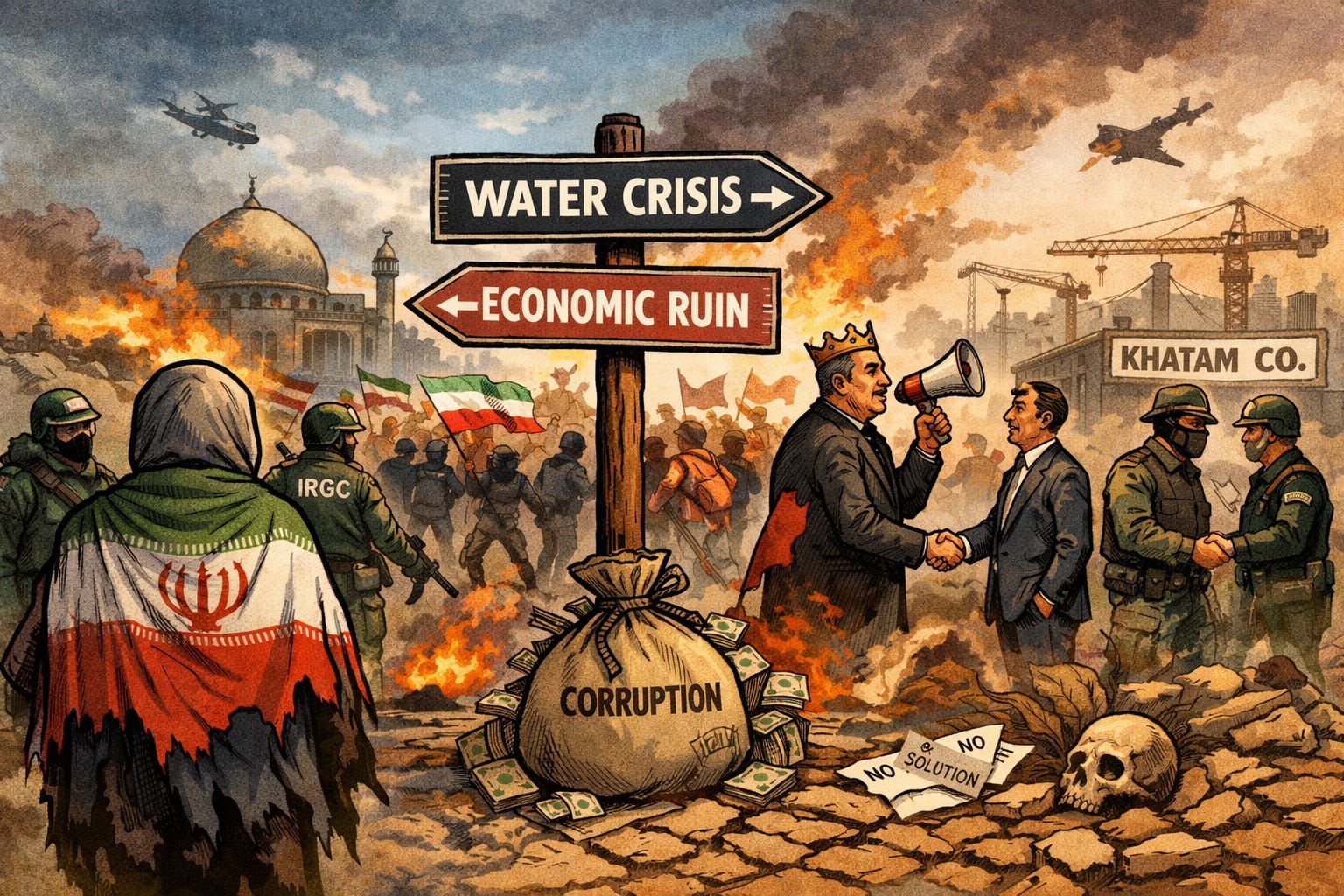
I have made the same point to people in think tanks and political circles. They should have paid far more attention to water stress, or what Kaveh Madani has called water bankruptcy, not as a complete explanation for Iran’s crisis, but as an important warning sign. Water bankruptcy is not a side issue. It is the kind of structural failure that can help set the stage for much larger social, economic, and political breakdowns.
I also remember clearly that some of the people now surrounding Reza Pahlavi were unhappy when I insisted that water had to be treated seriously and that practical solutions should be part of any responsible political discussion. Some argued that offering solutions might help stabilize the regime or reduce pressure on it. That was not my view.
My response was simple. In my opinion, this regime was never likely to address the problem in a sane or honest way. Given its record of corruption and patronage, I believed it was far more likely to pursue expensive and destructive pseudo-solutions that would benefit powerful networks, including actors linked to the IRGC’s Khatam al-Anbiya Construction Headquarters and what many critics describe as the wider water mafia. Looking back, I think I better understand why some people in that camp were uncomfortable with what I was saying, especially when I mentioned Khatam al-Anbiya by name. The late Masood Masjoody also voiced concerns about the possibility that some figures around Pahlavi might be open to accommodation with elements tied to the IRGC’s construction empire. I heard similar concerns from others as well, but I present them only as concerns that were raised to me, not as established fact.
The last three months have radicalized many people and polarized almost everyone. Some who once spoke about democratic values with conviction now appear willing to compromise those principles in favor of a future monarchy. Others have treated anyone who opposes both war and Pahlavi as part of the so-called Iran Lobby. The hate messages and threats many of us have received have been staggering. A man who had sued Reza Pahlavi and some of his followers was later murdered, and various media reports have attributed responsibility to the Revolutionary Guards or have focused suspicion there. I cannot independently verify those claims.
I cannot reduce all of this to a simple theory, or say that water mismanagement alone explains the hatred, fear, and political ugliness now surrounding us. Reality is more complicated than that. But I do believe this: when a country is damaged for years by bad governance, corruption, ecological collapse, and impunity, the consequences do not remain contained. They spread into politics, institutions, public language, exile communities, and private lives.
What I am seeing now is not just ordinary political disagreement. It is a growing hostility between people who genuinely want to save Iran and those who, in my view, are willing to follow manipulative or deceptive political projects, no matter the cost.
God help us all.
چه جوری هر جناح بدون برنامه ریزی علیه کمآبی میشه حکومت جدید بسازد؟
ایا جواب وازه برای این مشکل وجود دارد؟